
Stretcher transport in Basel and north-western Switzerland
For hospitals, clinics, care homes, medical practices and private individuals
The essentials first
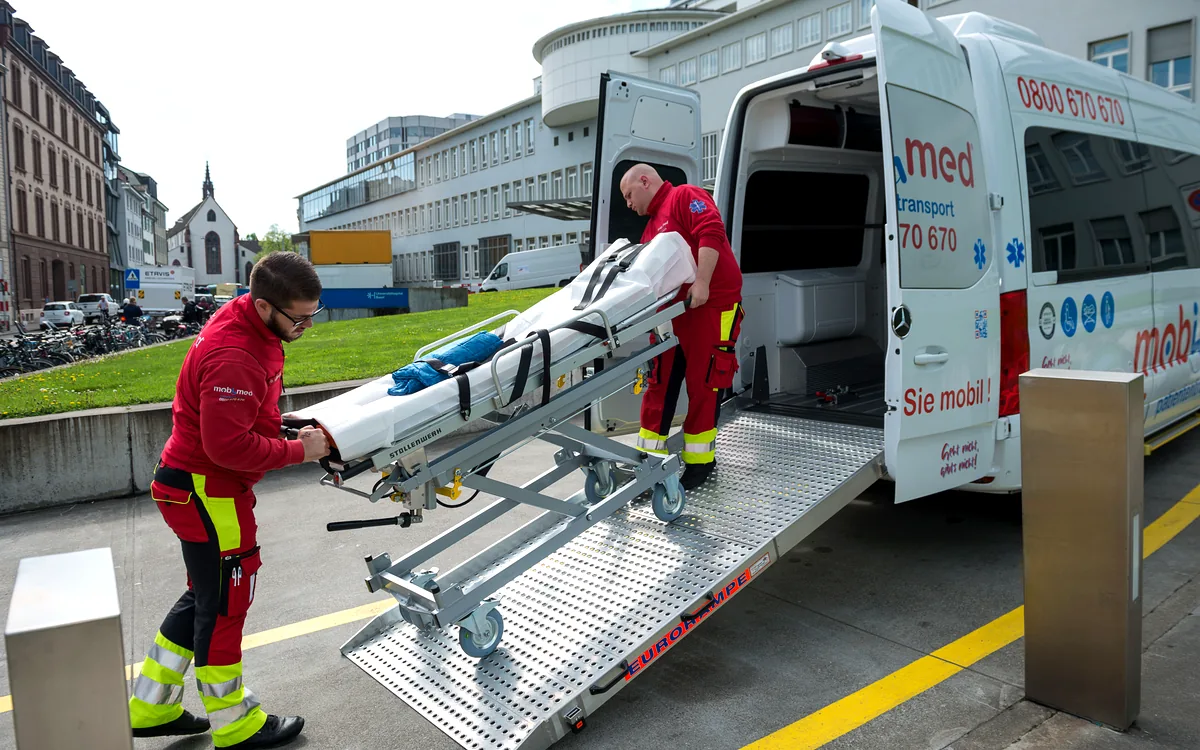
In a stretcher transport, the patient is carried on a patient stretcher in a vehicle specially equipped for the purpose. A second, specially trained transport assistant travels along and monitors the patient throughout the entire journey. Every stretcher transport vehicle carries oxygen, equipment for emergency first aid and a defibrillator.
Typical uses
- Hospital transfers between hospitals and clinics
- Returning home after a hospital stay
- Dialysis transport for patients with limited ability to sit
- Journeys to examinations and treatments
- Journeys abroad and medical repatriation
When a stretcher transport is the right choice
A stretcher transport is indicated when a seated position is not possible for the patient, not reasonable or not medically advisable. This often applies to the period directly after an operation, and to patients in severe pain, with circulatory problems when upright or with marked immobility.
Compared with seated transport, lying down puts considerably less strain on the body: the circulation is relieved, jolts are absorbed by the sprung stretcher, and the patient does not have to get in or out of the vehicle. Our staff take care of positioning the patient entirely.
How our stretcher transport vehicles are equipped
Every vehicle we use for stretcher transport meets the requirements prescribed for it. Standard equipment includes a wheeled patient stretcher with securing straps, oxygen, equipment for emergency first aid and a defibrillator on board.
The patient is accompanied by a second transport assistant who is trained for this task and keeps a constant eye on the patient during the journey. On request, a companion from the patient’s personal circle travels along free of charge.
Important: we are not an emergency service
Our services are designed for patients in a stable physical condition. We cannot provide assistance in emergency situations.
Emergency care, administering medication and maintaining vital functions must always be handled by the ambulance service. In an emergency, call 144.
Stretcher transport at Mobimed — in pictures
Our own photos from Basel — click to view them full size.
Frequently asked questions: Stretcher transport
What is a stretcher transport?
A stretcher transport is a medical transport in which the patient travels lying on a patient stretcher instead of sitting – for example after an operation, in severe pain or when sitting is not possible. A second, trained transport assistant monitors the patient during the journey; oxygen and a defibrillator are on board. A stretcher transport is not a rescue operation: in an emergency, call 144.
Does a second person always travel along on a stretcher transport?
Yes. On every stretcher transport, a second, specially trained transport assistant accompanies the journey and monitors the patient continuously. This is standard with us, not an optional extra.
Can a relative travel along?
Yes, one accompanying person travels free of charge. Please mention this when you book so that we can plan the seat.
How far in advance do I need to book a stretcher transport?
Ideally, book plannable transports one day in advance. We accept short-notice requests as soon as a vehicle is available – for these, please call us directly on 0800 670 670.
Is a stretcher transport the same as an ambulance?
No. An ambulance is intended for emergencies with medical care during the journey. A stretcher transport carries medically stable patients lying down and accompanied – without emergency care.
Perhaps this suits you better
Hospital transfers
For hospitals, clinics, care homes and relatives
Rehab transport
For patients, relatives, hospitals and rehabilitation clinics
Wheelchair transport
For hospitals, clinics, care homes, medical practices and private individuals
Medical repatriation & journeys abroad
For private individuals, relatives, hospitals and insurers
Before you book
What does health insurance cover?
Basic insurance, supplementary insurance, medical prescription — the rules that apply to this service.
Costs & health insuranceBook for yourself or a relative
No hospital needed in the background: online or by phone, and your companion travels free of charge.
For individualsWhich type of transport is right?
Stretcher, wheelchair, seated or taxi — the guide with a comparison and help to decide.
To the guideFor hospitals, care homes and Spitex
A permanent transport partner with case number, cost centre and a single contact person.
For hospitals & care homesTerms explained: Accompanying person · Deductible and co-payment · Defibrillator (AED) · Emergency medical service · Hospital discharge (discharge management) · Inter-facility transfer · IVR recognition · Medical prescription for transport · Medical repatriation · Medical transport · Patient stretcher (wheeled stretcher) · Patient transport · Patient transport paramedic · Rehabilitation (rehab) · Stair chair · Stretcher transport · Transport assistant · Transport costs and health insurance
Stretcher transport in: Basel · Riehen · Allschwil · Binningen · Bottmingen · Oberwil · Therwil · Birsfelden · Muttenz · Pratteln · Münchenstein · Reinach · Arlesheim · Aesch · Dornach · Liestal · Sissach · Laufen · Rheinfelden
Book transport — online, straight to our dispatch team
Client, patient, appointment — one form that goes directly to our dispatch team. Prefer to call? That works too.
The first IVR-recognised patient transport service in north-western Switzerland
Recognition by the Swiss Interassociation for Rescue Services (IVR/IAS) is not a self-assessment but the result of an external audit of vehicles, equipment, training and procedures. Mobimed was the first patient transport provider in north-western Switzerland to receive it — and still holds it today.
Check the certificate in the IVR register