
Patient transport in Basel: which type suits whom?
Lying down, in a wheelchair, seated — or will a taxi do? What sets the transport types apart, when patient transport makes sense and how to recognise a good provider.
Patient transport takes people who cannot travel on their own safely to the doctor, hospital, therapy or rehabilitation — and back home again. Which type of transport is right comes down to one simple question: can you sit, and how much help do you need? In an emergency, always dial 144.
- Lying down, if sitting is not possible or not permitted
- In a wheelchair, if you can only manage a few steps
- Seated, if you need someone with you but not a stretcher
- Accompanied from door to door — not just from kerb to kerb
What types of patient transport are there?
Mobimed matches the type of transport to your state of health and mobility. The main ones are:
- Stretcher transport — on the patient stretcher, with a second trained transport assistant. For the period after operations, in severe pain or when sitting is not possible.
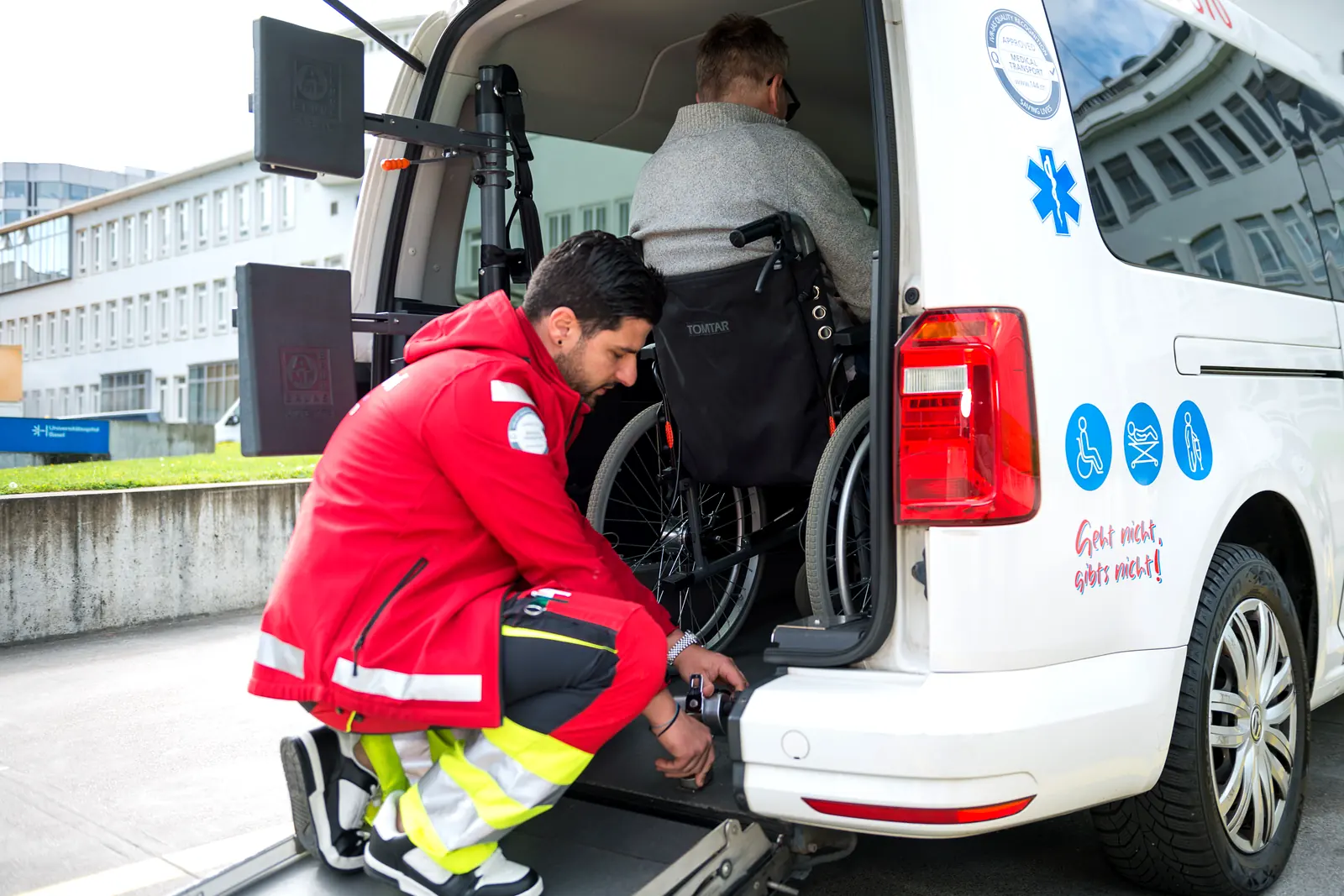
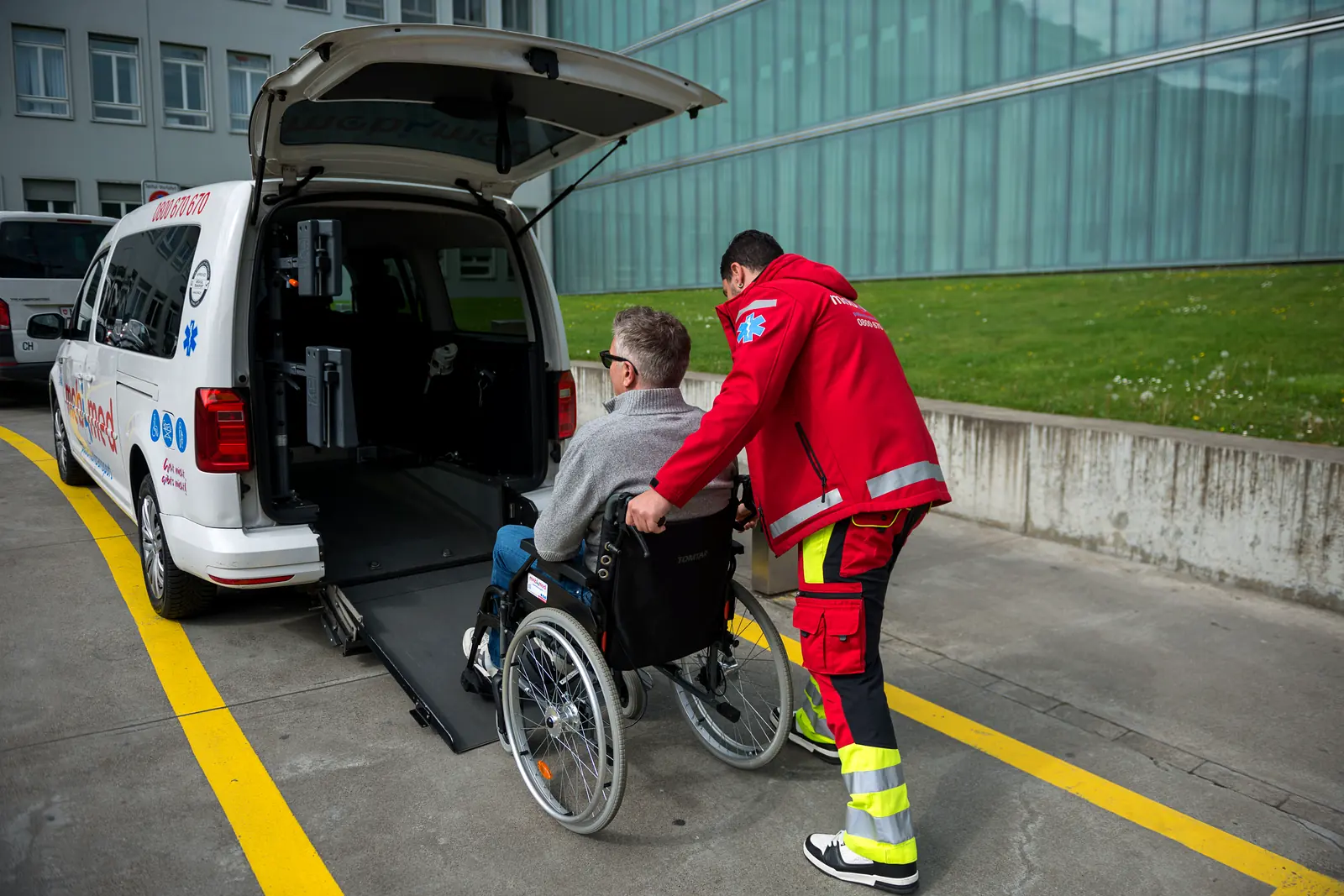
- Wheelchair transport — in your own wheelchair, into the vehicle via a ramp or lift, secured with an approved restraint system. No transfer needed.
- Seated transport — for medically stable patients who need support getting in and out of the vehicle and along the way.
- Transport for pregnant women — a calm journey to check-ups, or to hospital when labour begins.
- Rehabilitation and dialysis transport — recurring journeys on a fixed schedule, with the same drivers wherever possible.
Mobility, safety and strain
The wrong type of transport can make a journey needlessly exhausting — or dangerous.
| Type of transport | Suitable for | Safety | Risk if the wrong type is chosen | Strain |
|---|---|---|---|---|
| Stretcher transport | Anyone who must not or cannot sit: after operations, in severe pain, when bedridden | Very high | Circulatory problems and pain if transported seated | Very low |
| Wheelchair transport | Anyone who uses a wheelchair or can only manage a few steps | High | Risk of falling when transferring to a car seat | Low |
| Seated transport | Anyone who can sit but needs help and someone with them when getting in and out | High | Exhaustion and risk of falling without an escort | Medium |
| Taxi or private journey | Anyone who can walk and get in and out on their own | Low | No help at the door, no trained escort | High |
Four questions to the right type of transport
- Is it an emergency?Then dial 144 — not Mobimed. We only transport patients in a stable condition.
- Are you allowed to sit, and are you able to?If not: stretcher transport. This is often the case after hip or back surgery.
- Do you use a wheelchair or can you only manage a few steps?Then wheelchair transport — you stay in your own wheelchair and do not have to be transferred.
- Can you sit, but need help and someone with you?Then seated transport — accompanied from your home all the way to reception.
Not sure? Call us on 0800 670 670 (free of charge) — together with you or the care staff, we will work out the right type of transport.
When does patient transport make sense?
- After an operation or a hospital stay
- Journeys to rehabilitation or therapy
- Dialysis, radiotherapy and other recurring appointments
- With neurological or age-related conditions
- When everyday mobility is limited
- Transfers between hospitals, clinics and care homes
Patient transport, wheelchair taxi or taxi?
A taxi is designed for people who can get in and out on their own. A wheelchair taxi carries the wheelchair, but the assistance usually ends at the vehicle. Patient transport goes further: we collect you from your home, help you on the stairs, secure patient and wheelchair with approved systems, carry oxygen and a defibrillator on board, and accompany you to reception or onto the ward.
For hospitals, care homes and relatives, this means a journey for which nobody has to take time off — and the certainty that someone is there who knows what to do. Find out more about our wheelchair taxi service in Basel.
How to recognise good patient transport
- Recognition by the Swiss Interassociation for Rescue Services (IVR) — publicly verifiable
- Trained staff (IVR level 3 or higher) rather than mere drivers
- Vehicles with a patient stretcher, ramp or lift, oxygen and a defibrillator
- Assistance from door to door, not just from address to address
- Clear pricing information before you book
Mobimed is the first IVR-recognised patient transport provider in north-western Switzerland. Check the certificate in the IVR register.
How much does patient transport cost?
The price depends on the type of transport, the distance and how much assistance is needed — we tell you before you book. For medically necessary transport, basic health insurance (KVG/LAMal) usually covers 50 per cent, up to an annual maximum.
Costs and health insurance in detail
Goran Jovic
Managing Director of Mobimed Patiententransport GmbH. Together with his team, he is responsible for stretcher, wheelchair and seated transport in Basel, Basel-Landschaft, throughout Switzerland and abroad.
Meet the teamFrequently asked questions about patient transport
When do I need patient transport instead of a taxi?
As soon as you need help getting in and out, cannot walk safely on your own, have to remain seated in your wheelchair or are not allowed to sit after an operation. A taxi takes you from kerb to kerb — patient transport collects you from your home, secures you during the journey and accompanies you all the way to reception.
Which type of transport is right for me?
That depends on whether you can sit and how much strain you can cope with. If you are not allowed to sit or are in severe pain, you travel lying down. If you use a wheelchair or can only manage a few steps, you travel in your wheelchair. If you can sit but need someone with you, you travel seated. If in doubt, we will advise you by phone.
Is Mobimed an ambulance service?
No. Mobimed transports patients in a stable physical condition. In a medical emergency in Switzerland, always dial 144.
Does health insurance cover the costs?
For medically necessary transport, basic health insurance usually covers 50 per cent, up to an annual maximum. A medical prescription is usually required. Supplementary insurance often covers more.
Do I need a medical prescription?
Usually yes, if you want your health insurer to contribute. You can still book transport without a prescription — you then pay the costs yourself.
Can someone accompany me?
Yes. One accompanying person travels free of charge with every type of transport.
All types of transport: Stretcher transport · Wheelchair transport · Seated transport · Transport for pregnant women · Transport for people with disabilities · Wheelchair taxi service Basel · Hospital transfers · Rehab transport · Transport to medical examinations · Transport to the doctor · Transport service for seniors · Dialysis transport · Airport transfer · Medical repatriation & journeys abroad
Book transport — online, straight to our dispatch team
Client, patient, appointment — one form that goes directly to our dispatch team. Prefer to call? That works too.
The first IVR-recognised patient transport service in north-western Switzerland
Recognition by the Swiss Interassociation for Rescue Services (IVR/IAS) is not a self-assessment but the result of an external audit of vehicles, equipment, training and procedures. Mobimed was the first patient transport provider in north-western Switzerland to receive it — and still holds it today.
Check the certificate in the IVR register